
China Supplier Risk Intelligence
Where your biggest risk isn't quality —
it's not knowing who actually made your clothes.
Unauthorised subcontracting, fabric composition fraud, and labour compliance failures are endemic in Chinese garment manufacturing. Our audits go beyond production line checks to identify where your order actually gets made — and under what conditions.
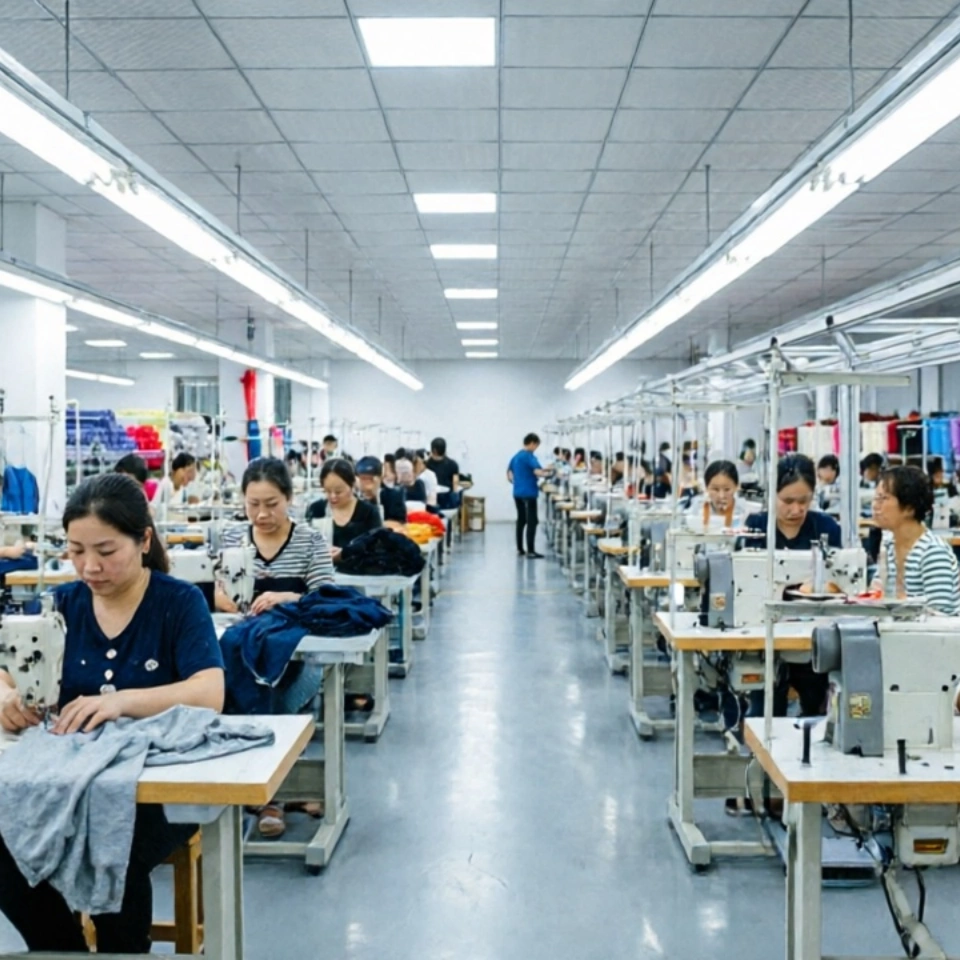
The garment industry's anatomy of failure.
Unauthorised Subcontracting
Your order is accepted, then quietly distributed to informal workshops the factory didn't tell you about — with no quality controls, no compliance standards, and no accountability.
Fabric Composition Fraud
You specify 100% cotton. The factory purchases a polyester-cotton blend and produces to specification on your sample — then substitutes cheaper fabric for the bulk run.
Labour Compliance Failures
Overtime beyond legal limits, piece-rate wages that require illegal hours to earn minimum wage, and missing social insurance contributions — risks with direct exposure under the EU CSDDD, UK Modern Slavery Act, and US import restrictions.
The factory you visited may not be the factory making your order.
This is the defining risk of Chinese garment sourcing, and it is dramatically underestimated by most buyers.
The factory you visited — with its clean production floor, organised cutting tables, and well-presented factory manager — is often not the factory that makes your order. In the Pearl River Delta and Yangtze Delta garment clusters, it is standard practice to accept orders at 150–200% of actual capacity, then distribute the overflow to a network of smaller workshops.
These workshops operate informally. They pay workers in cash, without formal contracts. They have no quality control procedures. They have no knowledge of your brand's compliance requirements. Workers are frequently paid per piece, creating pressure to cut corners on construction.
The problem is especially acute in fast-fashion and seasonal orders, smaller quantities that factories deprioritise, and factories presenting BSCI or SA8000 certificates — the certification covers the main facility; the workshop is invisible.
-
Capacity cross-check
Confirmed orders in production vs. floor capacity at time of audit. If the numbers don't reconcile, production is going elsewhere.
-
Worker interviews
Conducted independently, without factory management present, covering actual working location and daily production tasks.
-
Social security headcount vs. visible workforce
The official payroll enrollment vs. workers on the floor. Systematic gaps indicate informal workers — and often, external production.
-
Cutting room audit
Raw fabric volumes and cutting schedules cross-referenced against the production plan. Fabric going out means production going out.
-
Delivery records
Inbound finished goods arriving from external locations: who made them, and why?
-
Liaison staff identification
An "external production coordinator" role on the org chart is a direct indicator of managed subcontracting.
You order 100% cotton.
The bulk run arrives at 85% polyester.
Fabric procurement is the single largest cost variable in garment production, and many factories treat the buyer's material specification as a starting point for negotiation — one that happens without the buyer's knowledge.
Common substitution patterns: pure cotton replaced with cotton-polyester blend (visually similar, significantly cheaper); Modal / Tencel replaced with viscose (similar drape, lower cost); high GSM specification reduced to a lighter fabric that looks identical on a hanger and fails under wear; certified organic cotton replaced with conventional cotton using borrowed certification documents.
-
Raw fabric inventory audit
Supplier names, fabric cards, and delivery notes compared against your confirmed BOM and fabric specification.
-
Fabric storage cross-reference
Volume and composition on the floor matched against the production schedule. Discrepancies indicate substitution or external sourcing.
-
Supplier relationship verification
Is the factory buying from a certified fabric mill with traceable documentation — or from an unverified trader?
-
Approved sample reference check
The fabric in bulk production compared against the retained approved sample specification.
Your BSCI certificate covers the factory.
Not the workshop down the road.
The Chinese garment industry has endemic labour compliance issues that create direct exposure for brands selling into markets with supply chain due diligence requirements — the EU's Corporate Sustainability Due Diligence Directive (CSDDD), the UK Modern Slavery Act, and US import restrictions.
The most common failures: overtime beyond the legal 36-hour monthly maximum (80–120 hours is common during peak season); piece-rate wage structures that require illegal hours to meet minimum wage; no written employment contracts for migrant workers; and employer social insurance contributions routinely skipped for informal workers.
These issues are not visible from a management walkthrough. They require worker interviews, payroll record review, and social security cross-checking.
-
Social security records
Enrolled employees vs. visible workforce. The gap reveals the scale of informal employment.
-
Payroll record spot-check
Wage levels tested against minimum wage thresholds and legal overtime limits.
-
Employment contract sample review
Conducted with worker consent, confirming written contracts exist and cover actual terms.
-
Worker interviews
Conducted without factory management, covering working hours, wage receipt, and freedom to leave.
-
BSCI / SA8000 / SEDEX certification scope verification
Certification confirmed to cover the actual production facility — not just the registered office. Last audit date and open non-conformances reviewed.
What a SourcInspecify garment & textile factory audit covers.
Production Capability
- Real cutting and sewing line capacity vs. confirmed order volume
- Worker headcount by function: cutters, sewers, finishers, QC inspectors
- Equipment: machine types, brands, age, maintenance condition
- Sample room capability: in-house or outsourced?
Fabric & Raw Materials
- Fabric supplier credentials: certified mills vs. unverified traders
- Incoming fabric inspection (IQC): testing equipment, records, actual implementation
- Fabric storage: volume, composition, and condition vs. production schedule
- Trim and accessory suppliers: zips, buttons, threads — quality consistency
Labour & Social Compliance
- Social security enrollment vs. visible headcount
- Payroll records: minimum wage and overtime compliance spot-check
- Employment contracts: existence and terms
- Worker interview findings: hours, wages, freedom, working conditions
- Certification verification: BSCI, SA8000, SEDEX, OEKO-TEX scope and last audit
Financial & Operational Health
- Utility payment records vs. claimed production capacity
- Equipment financing and ownership status
- Order book review: is the factory over-committed relative to capacity?
- Key client concentration: dependency risk if one major buyer exits
The verification path for garment sourcing from China.
Background Check
Before any visit or payment. Verify the factory's legal status, ownership history, and financial anomaly flags. Essential for any new garment supplier.
Learn MorePre-Order Inspection
On-site before signing. Confirm real manufacturer vs. middleman, assess real production capacity vs. claimed, and evaluate labour compliance indicators.
Learn MoreIn-Progress QC
Mid-production at 30–50% completion. The most critical inspection for garment orders — when fabric substitution and subcontracting are most detectable and still correctable.
Learn MorePre-Shipment Assurance
Before the balance payment. AQL inspection, fabric composition spot-check, label and compliance document verification.
Learn MoreYour BSCI certificate covers the factory.
Not the workshop making your order.
Subcontracting, fabric fraud, and labour compliance failures are endemic — and detectable, if you know where to look.