
China Supplier Risk Intelligence
Because what you see in the showroom
is rarely what ships.
Material substitution, false FSC claims, and hidden subcontracting are the three most common ways furniture importers lose money in China. Our audits are specifically designed to catch all three — before your deposit leaves your account.
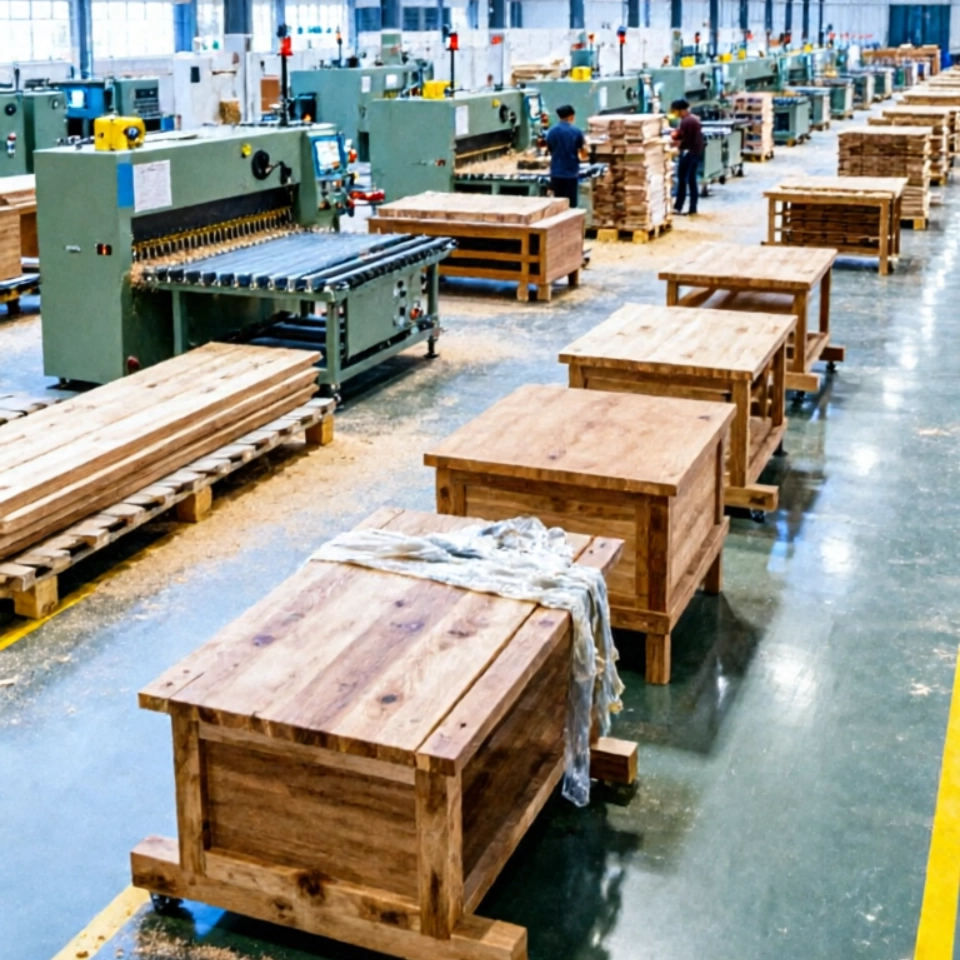
The furniture industry's anatomy of failure.
Material Substitution
Solid wood swapped for MDF mid-production. Oak veneer over engineered core, sometimes painted to obscure the seam. The most expensive and most common fraud in Chinese furniture manufacturing.
Certification Fraud
FSC certificates applied outside their registered scope. CARB/TSCA compliance declarations without underlying test reports. Certificates belonging to a parent entity used for an unrelated facility.
Hidden Subcontracting
Guangdong and Fujian furniture clusters operate on fragmented subcontracting models. A factory presenting you with an in-house production plan may be quietly distributing 30–50% of your order to uninspected workshops.
You order solid oak.
A container of MDF arrives.
You order solid oak dining chairs. The sample is perfect — heavy, well-jointed, genuine oak throughout. You place a $120,000 order. When the container arrives, you crack open a chair and find MDF core with oak veneer, sometimes painted over to obscure the seam. The factory passed your pre-shipment inspection because the inspector checked dimensions and finish — not material composition.
This pattern repeats across categories: solid teak swapped for plantation rubber wood, FSC-certified pine replaced with uncertified fast-growth alternatives, genuine rattan substituted with PVC wrapping. The substitution usually happens at the raw material sourcing stage — weeks before production begins — which is why pre-shipment inspection alone cannot catch it.
-
Raw material inventory at time of audit
Species verification, moisture content, grading documents matched against production orders.
-
Mill certificates and supplier invoices
Core material sourcing documented and verified against purchase records.
-
BOM cross-reference
Quoted Bill of Materials compared against actual materials present on the production floor.
-
Storage volume vs. production schedule
Does the wood inventory on-site match the volume of orders currently in production? Discrepancies indicate external sourcing.
The certificate is real.
The right to use it isn't.
FSC certification in Chinese furniture is widely misrepresented. Three patterns appear repeatedly:
Certificate scope mismatch: The factory holds a valid FSC certificate, but it covers only a subset of their operations — office furniture, for example — and they apply it to your residential furniture order, which is outside scope.
Certificate transfer: The factory uses an FSC certificate belonging to their parent company, their landlord's entity, or a previous factory on the same premises. The certificate is real; the factory's entitlement to it is not.
CARB and TSCA declaration without compliance: Factories produce CARB Phase 2 or TSCA Title VI compliance declarations without the underlying formaldehyde testing to support them — knowing that most buyers don't verify test reports against accredited lab records.
-
FSC certificate verification
Cross-referenced directly against the FSC database: certificate number, scope, expiry date, and chain of custody status.
-
CARB / TSCA underlying documentation
Compliance declarations traced back to the original third-party test reports; testing laboratory accreditation verified.
-
Certification scope confirmation
Your specific product category confirmed to be within the certificate's registered scope — not assumed.
-
Expiry and renewal status
Certificates within 6 months of expiry flagged; renewal trajectory assessed.
Your order may not be built at the factory you visited.
Furniture production in the Guangdong, Fujian, and Zhejiang clusters operates on a highly fragmented subcontracting model. A factory with 80 workers and 3 production lines will routinely accept orders requiring 5 lines' worth of capacity, then distribute the overflow to 2–3 smaller workshops.
These workshops have no relationship with you. They have no knowledge of your quality standards. They have no accountability if something goes wrong. And they are almost impossible to discover through a standard factory visit — because the main factory will present you with a production plan showing your order running entirely in-house.
-
Capacity utilisation vs. confirmed orders
If the factory's visible capacity cannot absorb all orders currently in production, overflow is going somewhere else.
-
Sub-supplier payment records and liaison staff
An "external production coordinator" role, or payments to unnamed workshops, is a direct indicator.
-
Finished goods arriving from external locations
Inbound completed components from offsite are documented and questioned.
-
Worker interviews
Conducted independently, away from factory management: "Where does the upholstery / lacquering / assembly actually get done?"
-
Social security headcount vs. visible workforce
A factory with 80 registered employees and 50 workers on the floor during a full production day is subcontracting.
What a SourcInspecify furniture factory audit covers.
Production Capability
- Actual capacity by product line — verified against visible equipment and workforce
- Equipment model and vintage (Italian vs. domestic machinery)
- Finishing workshop: water-based vs. solvent-based lacquer, VOC records
- Packaging capability matched against confirmed export order volume
Raw Materials & Supply Chain
- Primary wood and panel supplier credentials — traceable to certified source where claimed
- Hardware, fabric, and leather supplier list: stability and compliance record
- Raw material inventory matched against orders in production
- Incoming quality control (IQC) records: actually implemented or purely documentary?
Compliance & Certification
- FSC: direct database verification
- CARB Phase 2 / TSCA Title VI: underlying test reports and lab accreditation
- California Prop 65 chemical controls (where applicable)
- Export market-specific requirements: EU REACH, Australian AS/NZS standards
Financial & Operational Health
- Utility bills: 12-month data compared against claimed production capacity
- Social security enrollment: headcount consistency with visible workforce and stated capacity
- Equipment financing and encumbrance status: is key machinery already pledged to a lender?
- Major client export records: customs data verification where accessible
The verification path for furniture sourcing from China.
Background Check
Before any factory visit or deposit. Verify the factory's legal entity, litigation history, and ownership anomalies. Start here for any new supplier.
Learn MorePre-Order Inspection
On-site factory visit before signing. Confirm real manufacturer vs. trading company, assess production capacity and material sourcing, and get a clear verdict.
Learn MorePre-Shipment Assurance
Before releasing the balance. Full AQL inspection, material spot-check, FSC/CARB document verification, and quantity confirmation.
Learn MoreSeasonal Factory Audit
For ongoing suppliers. Periodic financial health re-assessment, equipment condition update, and trend report.
Learn MoreOrdering furniture from China?
Talk to us before you place your deposit.
Material substitution, certification fraud, and hidden subcontracting are preventable — if you know what to look for before you commit.