

Here’s a scenario I’ve seen more than once. A buyer hires a sourcing agent to find a factory in China. The agent does — takes a 5% commission on the upcoming order — and then offers to also run the supplier verification. “I know this factory well,” the agent says. “I’ll handle the audit.”
Something about that sentence should stop you.
Not because the agent is dishonest. Most aren’t. But the moment the same person who earns income from a supplier relationship is also writing the report on whether to trust that supplier, you’ve got a structural problem that good intentions can’t fix.
This isn’t a niche issue. It’s baked into how most China sourcing works — and it costs buyers real money. Let me explain exactly what’s happening and how to tell whether your own arrangement has this problem.
How Commission-Based Sourcing Agents Actually Get Paid
Before anything else, you need to understand the revenue model — because that’s where the conflict starts.
Commission-based agents typically earn 3–10% of your FOB order value. On a $50,000 production run, that’s $1,500 to $5,000 tied to a single transaction. There are three common structures in the market:
Percentage of order value. The agent earns a cut of everything you spend. Their income grows with your order size. There’s no financial incentive for them to find a cheaper factory, negotiate harder on your behalf, or flag a quality concern that might slow down or kill the deal.
Flat fee per project. Structurally cleaner than commission. But if the same agent is sourcing the factory and auditing it — and they have existing relationships with the factories they recommend — the familiarity itself creates a kind of soft conflict. Not corruption. Just proximity.
Hidden factory rebate. The most common arrangement that buyers never see. The agent quotes you the factory’s “public price,” negotiates a private discount, and keeps the difference. You pay a rate you think is market. It isn’t. And the agent has every reason to recommend whatever factory gives them the best rebate — not the factory that’s best for you.
In Models A and C, the agent’s income is directly tied to the deal closing. That’s the foundation of the conflict. Everything else follows from it.
Why the Same Entity Cannot Do Both Jobs
Three structural arguments. Any one of them is sufficient. Together, they’re decisive.
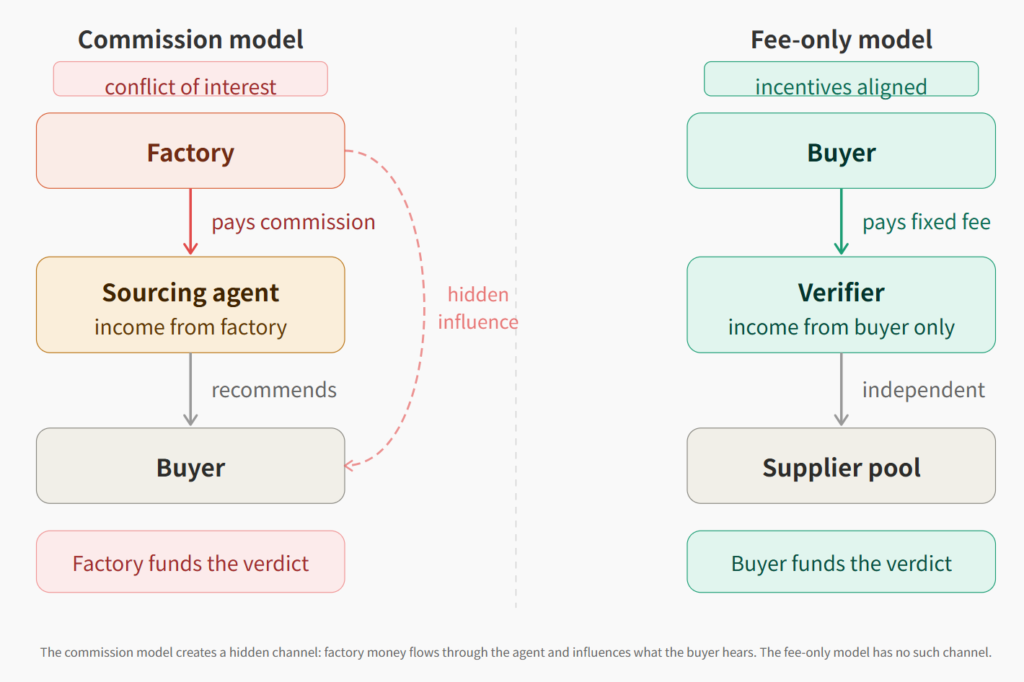
Audit independence requires no financial stake in the outcome. The international assurance standard ISAE 3000 — the framework I operated under during my years at Deloitte — is explicit on this: an assurance provider cannot hold a financial interest in the entity being assessed. This isn’t a best practice. It’s a definitional requirement for the assessment to have any validity. Apply that standard to supplier verification: an agent earning commission from a factory cannot produce objective output on that factory’s risk. Not because of bad faith. Because the structure makes independence impossible.
Commission agents source from the layer where their commissions live. Most sourcing agents build their networks through Alibaba, trade shows, and existing relationships — factories already equipped for export, already paying platform fees, already running a sales team. That infrastructure has a cost, and it’s priced into the quote you receive. The domestic-facing manufacturers, the government-certified 专精特新 enterprises, the upstream supply chain factories with no export overhead — they have no commission structure for an agent to access. So agents don’t find them. Not because they’re lazy. Because there’s no money in it. For more on this, see the complete guide to China supplier verification.
The timing bind. By the time an agent offers to audit a supplier, they’ve already sourced that supplier, already positioned themselves to earn the commission, already started imagining the income. An audit conclusion of “Do Not Recommend” wipes all of that out. The audit happens downstream of the financial commitment. There is no scenario — none — where the agent’s income and a genuinely independent verdict are perfectly aligned.
The Credit Analyst Question Nobody’s Asking

Here’s a question most supplier verification in China never asks: is this business financially capable of honoring your contract six weeks from now?
That’s different from “does this factory have acceptable production quality today.” Both questions matter. But only one of them shows up in most audit reports.
At Standard Chartered, before we approved a credit line, we didn’t just visit the company’s premises. We read balance sheets, traced capital contributions, pulled court records, checked how the ownership structure connected to any other entities with liabilities. That methodology translates directly to supplier due diligence — and most of the data is publicly accessible in China if you know where to look.
Two signals that a QC firm or commission agent almost never surfaces:
Registered capital versus paid-in capital. China’s business registry lets founders declare a capital commitment (registered capital / 注册资本) without actually depositing it. Paid-in capital (实缴资本) is what shareholders actually contributed. A factory showing RMB 5,000,000 registered with RMB 0 paid in has owners who signed a promise they never kept. No equity cushion. If a quality dispute goes sideways and you need financial recourse, there’s nothing there. This number is on the business license and freely searchable on GSXT (国家企业信用信息公示系统).
Court enforcement records. China’s Supreme People’s Court publishes a list of entities that have defaulted on court-ordered obligations — 失信被执行人, or “dishonest judgment defaulters.” This is accessible through GSXT and platforms like Tianyancha. A supplier on this list has already failed to honor legal obligations. None of this data appears in any English-language supplier database. It requires a Mandarin-language account and the knowledge to know what to look for. Commission agents don’t check it. Not out of negligence — it just doesn’t affect their commission whether they find something or not.
A Pattern That Comes Up More Often Than It Should
The pattern is consistent enough that I’d call it a signature: a buyer has worked with a factory for several years, built up trust through their agent, and then gets blindsided by something that the agent’s audit should have caught. When I run an independent background check afterward, the data is usually sitting there in the registry — not hidden, not obscured. Just unread by anyone who had a financial reason not to look too carefully.
The agent wasn’t lying. They were structurally unable to perform the function the buyer thought they were paying for.
Three Questions to Ask Before You Proceed
If you’re in a situation where your sourcing agent is also offering verification services — or you’re trying to figure out if this applies to your current arrangement — here are three direct questions that will tell you what you need to know.
Question 1: Do you receive any income from the factories you recommend? Ask this in writing. A legitimate fee-only verifier answers immediately and completely. Evasion, deflection, or “that’s a standard industry arrangement” means the answer is yes and they’d prefer you not think about what that means.
Question 2: If your assessment of this supplier is “Do Not Recommend” — what happens to your fee? If the verifier gets paid regardless of the outcome, the incentive structure is independent. If their compensation depends on the deal proceeding, the audit’s independence is compromised by design.
Question 3: Where did the factories on my shortlist come from? “Our existing network and Alibaba” means you’re in the visible layer. “Government certification registries, customs export data, enterprise registry searches, and industrial cluster contacts” means the verifier has access to channels where no commission relationship exists. This distinction matters more than most buyers realize. See how to verify whether you’re dealing with a factory or trading company for the practical check.
The Verdict
Let me be direct, because this is a situation where hedging doesn’t help you.
If your sourcing agent is paid on commission — whether as a percentage of order value or through factory rebates — don’t ask them to audit the supplier they found. The financial structure makes independent judgment impossible, and that’s true regardless of how experienced or well-intentioned the agent is. Get independent verification before you commit capital.
If your agent charges a flat project fee with no supplier-side income, the structural conflict is substantially reduced. You can use them for what they’re good at: Mandarin communication, logistics coordination, relationship management. But still run a separate background check on any new supplier before significant orders. At $39.9, a background check covering paid-in capital, court records, and social security headcount is cheaper than an expedited sample shipment.
If you already have a sourcing agent you trust for execution and keep verification separate — that’s the right architecture. Use each function for what it’s structurally suited for.
A good sourcing agent is genuinely valuable. But asking them to also audit their own recommendations requires them to work against their own financial interest. An agent who finds your factory and audits your factory is like a lawyer who represents both sides of a contract. The documents might look fine. The conflict isn’t in the paperwork — it’s in whose interests are actually being served.
One more thing worth naming: commission-based agents operate predominantly in the visible, Alibaba-accessible layer of China’s manufacturing market — the channel where their commission relationships live. The question of whether a better factory exists in a layer they can’t access is a separate conversation, but it starts from the same place: when incentives are aligned with the buyer, not the factory, you see things others don’t.
Before You Sign the Purchase Order
If you want the checks described in this article — business registration, paid-in capital, court enforcement records, social security headcount cross-reference — our Supplier Risk Assessment covers all of it. $39.9. Two-business-day turnaround. Plain-language verdict: Recommend, Conditional, or Do Not Recommend.
If you want the supplier shortlisting done independently from the start — sourced from channels where no commission relationship exists — our Supplier Selection service starts at $399. One fixed fee. Zero income from any supplier on your list.
For a full framework on applying financial credit-risk methodology to China supplier verification, the complete guide covers everything from registry checks to on-site audit methodology.
Written by Roger Yang, founder of Sourcinspecify. Roger is a former Big Four auditor (Deloitte) and bank credit analyst (Standard Chartered) with experience across 500+ factory visits and supplier due diligence engagements across China. He holds a CISA certification and specializes in applying financial credit-risk frameworks to China supplier selection and verification.