You found a supplier on Alibaba. They have a Gold Supplier badge, professional photos, and a five-star response rate. Their quote is competitive. You’re ready to move forward.
Trust them with confidence after verification
Before you wire the deposit: most of what you just evaluated tells you almost nothing about whether you’re dealing with a real manufacturer.
The Alibaba supplier verification system is built to tell you the supplier paid for membership and responds to messages. It does not tell you who actually makes the product, whether the company is financially solvent, or whether the factory on the listing has any connection to the entity that will cash your payment. These are different questions — and they require different checks.
Here are 8 red flags that separate real manufacturers from traders, resellers, and financial risks. The first three are observations I’ve made across hundreds of factory visits. The rest require a few minutes of desk research that most buyers skip entirely.
Red Flag 1: Their Product Range Covers Unrelated Industries
A manufacturer makes one thing — or a tightly related family of things — because manufacturing capability is built around specific processes, materials, and equipment. A furniture factory has woodworking machinery. A garment factory has industrial sewing equipment and pattern-cutting tables. Neither of those can be converted to produce electronics or kitchenware without a completely different capital investment.
When a supplier’s Alibaba storefront lists solar panels alongside yoga mats, or industrial pumps alongside promotional gifts, they are not a manufacturer. They are a trading company with purchase agreements across multiple product categories. The breadth of their range is the tell: the more categories they span — especially across unrelated industries — the more certain you can be that they make nothing themselves.
The version of this that trips buyers up: a supplier showing a slightly broader range within one category (e.g., a furniture company offering both solid wood and metal furniture). This is less conclusive. The disqualifier is cross-industry coverage — electronics and textiles, hardware and apparel — because no production infrastructure supports both.
Red Flag 2: Their Product Photography Is Too Good
This one sounds counterintuitive, but it’s reliable: professional, styled product photography — clean backgrounds, matched lighting, consistent art direction, lifestyle shots — is a trading company signature.
The logic is straightforward. A trading company needs to sell at a markup. The only way to justify a higher price than the factory price is to make the product look more valuable. High-quality images exist to support premium pricing. A factory selling at ex-works prices doesn’t need lifestyle photography. They need technical specs and a price list.
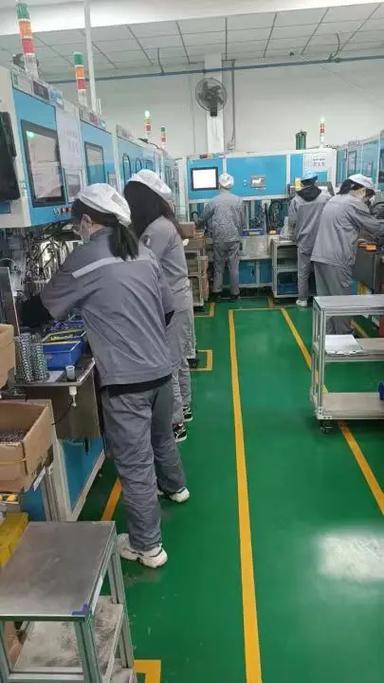
What real factory listings typically look like: raw production floor shots, product photos with measuring tape or scale reference, images that include visible factory context (lighting racks, concrete floors, equipment in background). These aren’t polished — because the factory’s product is their capability, not a consumer presentation.
The tell is the absence of any production-context imagery combined with a complete set of styled commercial photos. If every image looks like a brand catalog shoot and you can find zero evidence of a production environment, you are almost certainly looking at a reseller’s listing.
Red Flag 3: Their Org Chart Has Sales and Product Departments — No Production or QC
Some suppliers on Alibaba list their organizational structure. When they do, read it carefully.
A trading company has salespeople, sourcing staff, and sometimes a product development team. They don’t have a production department because they don’t produce anything. They don’t have an in-house quality control team because they don’t control the production line — they can only inspect what the factory delivers to them.
A real manufacturer has production supervisors, line managers, QC inspectors, and often an engineering or technical team. When a supplier’s listed departments are exclusively commercial — sales, export, product management — with nothing on the operations or production side, that absence is the answer.
This check takes thirty seconds. On Alibaba, go to the company profile, look for the “Company Overview” section, and scan for any production or manufacturing function. If the entire organization exists only to sell and coordinate — not to build anything — you know what you’re dealing with.
Red Flag 4: The Gold Supplier Badge on Their Profile
Gold Supplier status on Alibaba means the company paid a membership fee, verified a business license, and optionally added a third-party audit. It does not mean the company manufactures what they sell. It does not assess financial health, production capability, or business ethics. It is a marketing tier.
This matters because buyers routinely use Gold Supplier status as a primary trust signal. In reality, Gold Supplier tells you the company is willing to pay for visibility on Alibaba. That’s all. Over 2,100 Gold Suppliers were delisted in 2023 alone for falsifying certifications — with the badge in place right up until removal.
The correct use of the Gold Supplier filter: it reduces the probability of a completely fictitious listing, because verifying a business license requires some real-world connection. But it does nothing to answer whether the supplier is a manufacturer or trader, whether they’re financially stable, or whether they’ve been involved in legal disputes. Treat it as a minimum baseline, not a verification.
Red Flag 5: The On-Site Inspection Video Is Labeled “Associate Company”
Alibaba’s Verified Supplier program includes a video inspection of the supplier’s premises, conducted by SGS. This is actually a useful signal — if you read the label correctly.
If the video label says “Suppliers company,” you’re looking at the actual premises of the entity you’re dealing with. If it says “Suppliers associate company,” “Suppliers affiliate company,” or “Suppliers partner,” you are looking at a different company’s facility — most likely the actual manufacturer that the trading company has an arrangement with.
The implication: the factory in the video is not who you’ll be contracting with. Your commercial relationship, and your legal recourse if something goes wrong, is with the trading company — not the facility where the goods are actually made. Go to the Company Profile → Company Overview on any Verified supplier profile and check the video label before anything else.
Red Flag 6: Their Business Registration Shows 贸易 (Trade) in the Company Name
China’s business registry is publicly accessible through GSXT (国家企业信用信息公示系统) and third-party platforms like Tianyancha or Qichacha. Searching a supplier’s registered company name takes two minutes and reveals more than any Alibaba badge.
The first thing to look for: the company name itself. Chinese company names that include 贸易 (màoyì, meaning “trade”) or 进出口 (import-export) in the official registered name are trading companies by legal designation. A company registered as “XX 贸易有限公司” is not a manufacturer — it’s a trade entity. This is not a gray area; it’s the company’s own legal registration.
The second thing to look for: the stated business scope (经营范围) on the license. Real manufacturers list production-related activities — 生产 (production), 制造 (manufacturing), 加工 (processing) — alongside sales. Trading companies list only 销售 (sales) and import-export activities, sometimes covering dozens of product categories in the same license, because they’re not constrained by production capability.
This check requires a Chinese platform account or the ability to read basic Chinese characters. It’s the most definitive factory vs. trader verification available — and it’s free.
Red Flag 7: Registered Capital Is High; Paid-In Capital Is Zero
This is the check that almost no buyer runs — and the one that a credit analyst runs first.
Chinese company law allows founders to register a company with a stated capital commitment (registered capital / 注册资本) that they don’t actually have to pay in on day one. Paid-in capital (实缴资本) is what the shareholders actually contributed. The gap between the two is the gap between a financial commitment and a marketing number.
A supplier with RMB 10,000,000 in registered capital and RMB 0 in paid-in capital has shareholders who made a legal commitment they never followed through on. The company has no actual equity cushion. In a dispute — a defective batch, a delayed shipment, a quality claim — the company has no financial buffer to make you whole. This information appears on the business license and in the GSXT registry.
This signal alone doesn’t automatically disqualify a supplier. Many legitimate small manufacturers operate with partially paid-in capital. The red flag is the combination: zero paid-in capital plus a headcount in the social security records (社保) that’s dramatically lower than the production capacity they claim. A factory claiming 200-unit daily output should be employing and insuring enough workers to sustain it. If social security records show 8 registered employees — a figure also accessible through Chinese databases — the stated capacity is not real.
After four years of seamless transactions with an Alibaba Gold Supplier, a buyer confidently placed a substantial bulk order worth $120,000 for custom-manufactured electronic components. The supplier’s verified profile and flawless transaction history provided a false sense of security. However, the shipment arrived with a catastrophic 45% defect rate, rendering the entire batch unusable for the buyer’s assembly line. When the buyer filed a quality claim, the supplier was completely unable to offer a refund, replacement, or compensation. It was later discovered that the company had no financial standing to honor the claim, leaving the buyer to absorb the full $120,000 loss while facing severe production delays.
A subsequent background check by me uncovered critical red flags that explained the collapse. The supplier had three outstanding labor arbitration claims filed within the prior 12 months, indicating severe internal management and financial distress. More alarmingly, the company’s registered capital was RMB 2,000,000, yet the paid-in capital was exactly RMB 0, meaning the owners had invested no actual money into the business. Furthermore, the supplier claimed a production capacity requiring over 60 workers per shift, yet social security registrations showed only 11 employees. This massive discrepancy strongly suggested the supplier was heavily subcontracting the order to unverified, low-quality workshops without proper quality control.
If my comprehensive background check had been conducted before the order was placed, his verdict would have been an immediate and absolute “DO NOT PROCEED.” I would have flagged the zero paid-in capital and the labor arbitrations as definitive signs of a financially hollow and legally troubled entity. The glaring mismatch between the stated workforce and actual social security registrations would have confirmed the supplier was merely a middleman outsourcing to unreliable factories. I would have advised the buyer to terminate the relationship immediately, thereby preventing the $120,000 financial hemorrhage and saving the buyer from a devastating supply chain failure.
Red Flag 8: They Can’t Answer Production-Specific Questions
A real manufacturer can answer production questions immediately, specifically, and without hesitation — because the answers are embedded in how they run their operation every day.
Ask your supplier: What’s your raw material sourcing location for this product? What’s your typical reject rate at final QC? What equipment do you use for [specific production step relevant to your product]? How do you handle a defective batch mid-production?
A trading company’s sales rep doesn’t know the answers to these questions because they don’t run the factory. They’ll either deflect (“let me check with the factory and get back to you”), give vague non-answers (“we use high-quality materials and strict quality control”), or provide answers that don’t match the product category they claim to specialize in.
A manufacturer’s response is immediate and specific: the grade of steel, the origin province of the fabric, the production line configuration, the specific test they run before releasing a batch. Specificity on production questions is the fastest real-time check available.
The Verdict
Not all eight red flags carry equal weight. Because now we are in the world of Ai, anything in the web is possible. Digital is easy to be manipulated. Just put more efforts into supplier finding and set high requirements in advance.
Some of these flags are standalone disqualifiers — one is enough to walk away. Others are confirmation signals: they don’t disqualify alone, but two together indicate a structural problem worth taking seriously.
Standalone disqualifiers:
Red Flag 1 (cross-industry range), Red Flag 6 (business registration confirms 贸易 with no production scope)
Combination signals:
Red Flag 7 (zero paid-in capital + mismatched social security headcount requires both signals together to constitute a hard stop)
The Gold Supplier badge (Red Flag 4) is neither. It’s simply irrelevant to these questions — a marketing indicator that tells you nothing about manufacturing capability or financial health.
The broader issue: these red flags are widespread on Alibaba because the platform’s verification system screens for operational presence, not financial health or manufacturing capability. Alibaba can confirm a company exists and responds to inquiries. It cannot tell you who actually makes the product, whether the company can absorb a quality dispute, or whether better alternatives exist in channels the platform doesn’t touch.
That last point is worth sitting with. Avoiding the red flags in this article gets you to a supplier who isn’t obviously a trader or a financial risk. It doesn’t get you to the best available supplier — which may not be on Alibaba at all.
[See More: why-90-percent-china-manufacturers-not-on-alibaba — “Why 90% of China’s Best Manufacturers Never List on Alibaba”]
Before You Contact This Supplier
If you have a supplier in mind — whether from Alibaba or anywhere else — and you want to run the checks described in Red Flags 6, 7, and the organizational review: that’s exactly what our Background Check covers.
For $39.9 and a two-business-day turnaround, we run the Chinese government database checks, pull the registration records, cross-reference the social security headcount, and give you a plain-language verdict: Recommend, Conditional, or Do Not Recommend. The report covers what you can’t access without Mandarin-language database tools and a mainland China account.
If you want the supplier shortlisting done from scratch — including sourcing from channels beyond Alibaba — our Supplier Selection service starts at $399.
Written by Roger Yang, founder of Sourcinspecify. Roger is a former Big Four auditor (Deloitte) and bank credit analyst (Standard Chartered) with experience across 500+ factory visits and supplier due diligence engagements across China. He holds a CISA certification and specializes in applying financial credit-risk methodology to China supplier verification and selection.
Financial-Grade Due Diligence
Free Consultation
Tell us about your sourcing situation.
We'll review your case and respond within 2 hours
with a tailored recommendation.
No commitment required
2-hour response guarantee
Big Four & Banking auditors
Thank You for Reaching Out!
We have received your inquiry and will get back to you
within 2 hours. A confirmation email is on its way to your inbox.
While you wait
Review our sample verification report to see exactly what you'll receive —
the level of detail, the auditor verdicts, and the financial-grade analysis.